
TL;DR — Quick Q&A Summary
- Do you need a real estate license to be a Transaction Coordinator? In most states, it is not required, but you must always confirm your state rules and brokerage requirements.
- Do real estate courses prepare you for TC work? Not fully—they focus on law and compliance, not execution.
- What’s the biggest gap? Real-world workflow, systems, and transaction management.
- What should new TCs focus on first? Contracts, timelines, and communication.
- Why are contracts so important? They dictate the entire transaction process and deadlines.
- How do you actually learn the role? Through structured systems and real-world application.
A lot of people enter the real estate space thinking they’re doing the right thing.
They take a course.
They study hard.
They learn the terminology.
And then, when it’s time to actually work inside a transaction, something feels off.
They understand the concepts, but they don’t feel prepared.
If that sounds familiar, you’re not missing something.
You’re experiencing the gap between education and execution.

Heads up: This post contains affiliate links. If you choose to make a purchase through them, I may earn a small commission at no additional cost to you. I only recommend tools and services I personally use or trust. You can read the full affiliate disclosure here
Table of Contents
Does Taking a Real Estate Course Help You Become a Transaction Coordinator?
This is where a lot of confusion starts.
In most states, you don’t need a real estate license to become a Transaction Coordinator. But many aspiring TCs still consider taking a real estate course because they assume it will give them an advantage.
And to be fair, it can.
A real estate course exposes you to important concepts like contracts, timelines, and legal responsibilities. It helps you understand how transactions are structured and what agents are required to do to stay compliant. That foundation is valuable, especially if you’ve never been part of a transaction before.
And this part matters more than most people realize.
As a Transaction Coordinator, you are supporting a licensed professional. That means your work directly affects their business and, in some cases, their license. If you don’t understand the basics of how contracts work or what is required for compliance, it becomes very easy to make a mistake that could create issues for the agent.
This is why being aware of the law is not optional. You don’t need to be an attorney, but you do need to understand enough to operate responsibly within the transaction.
However, this is where expectations and reality start to separate.
Real estate education is designed to prepare agents to operate within the law. It focuses on compliance, regulations, and protecting the public. That’s why so many agents finish their course and feel unprepared to actually run their business.
They understand the rules.
But they don’t know how to:
- manage multiple transactions at once
- build systems to stay organized
- communicate efficiently with all parties
- handle real-world issues that come up during a deal
And as a Transaction Coordinator, those are the exact skills that define your performance.
One of the things I always tell aspiring TCs is to start with the contract and the related documents.
Because if you’re not familiar with them, you won’t be able to do much.
The contract dictates the pace of the transaction. It tells you what needs to happen, who is responsible, and when it needs to be completed.
In other words, the contract gives you the rules of the game.
So yes, taking a real estate course can give you exposure and context.
But it won’t teach you how to operate as a TC.
That gap is what this post is really about.
Why Smart People Still Feel Unprepared After Real Estate School
This is not about intelligence or effort.
Most people who take a real estate course are capable and motivated. They follow the material, pass the exams, and understand the terminology.
But the structure of that education is designed for a different purpose.
It teaches you how to:
- stay compliant
- understand legal obligations
- avoid violations
It does not teach you how to:
- manage a live transaction
- coordinate multiple parties
- handle time-sensitive decisions
- operate efficiently under pressure
So when you step into a real transaction, you’re not failing.
You’re just operating in a space you were never trained for.
Not Sure If This Is the Right Path for You?
At this point, you might be realizing that understanding real estate and actually working inside transactions are two very different things.
And that raises a bigger question.
Is the Transaction Coordinator role actually the right fit for you?
If you’re still figuring that out, I created a quick quiz to help you get clarity on whether you’re better suited for a General Virtual Assistant role, a Real Estate Virtual Assistant, or a Transaction Coordinator.
👉 https://cvpvirtual.com/quiz-va-reva-tc/
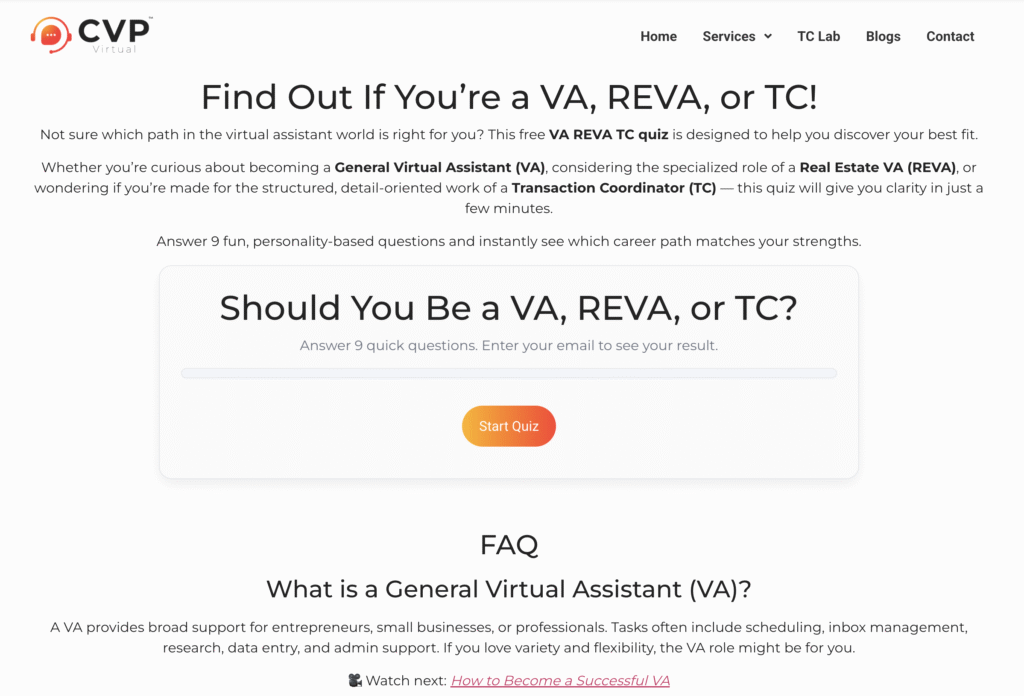
It only takes a few minutes, and it can save you a lot of time going in the wrong direction.
What Real Estate Courses Don’t Show You
Let’s move from theory into reality.
Because this is where most people realize the gap.
Imagine this:
It’s late afternoon, and an appraisal just came in below value.
The agent is waiting for options.
The buyer is unsure how to proceed.
The lender needs direction.
Nothing about that situation is theoretical.
There is no multiple-choice answer.
Now think about a missed deadline.
If an inspection period expires without action, the buyer could lose leverage or protections they didn’t even realize they had.
That’s not a small mistake.
That’s a transaction-level consequence.
This is the kind of environment Transaction Coordinators operate in.
Not controlled scenarios, but moving pieces that require awareness, timing, and communication.
What Actually Prepares You for TC Work
If real estate courses focus on knowledge, transaction coordination requires application.
The difference is not what you know.
It’s how you use it.
To operate effectively as a TC, you need to understand:
- how to read and interpret contracts
- how to calculate and track deadlines
- how to communicate with multiple parties at the same time
- how to anticipate issues before they escalate
And most importantly, how to connect all of that into a repeatable process.
See What This Actually Looks Like in Real Life
Reading about the gap is one thing.
Seeing how a transaction actually unfolds is where everything starts to make sense.
In this walkthrough, I break down what happens from contract to close, including how to review documents, track deadlines, and coordinate with all parties involved.
For example, something as simple as a missing signature can delay a transaction, and incorrect timelines can create issues that need to be corrected before moving forward .
This is the level of detail that defines your effectiveness as a Transaction Coordinator.
What You Actually Need (That Courses Don’t Teach)
Real estate education gives you awareness.
Running a TC business requires structure.
Professional Awareness and Responsibility
You are handling contracts, personal information, and timelines tied to real financial decisions.
That requires:
- attention to detail
- understanding of compliance
- awareness of how your work impacts the agent
This is where your understanding of the law becomes practical.
Legal Protection and Agreements
Clear agreements are not optional.
A Transaction Coordinator Agreement defines your scope, responsibilities, and boundaries. Without it, expectations become unclear, and that’s where issues begin.
This is also where legal templates, policies, and proper business setup become important. Protecting your business early allows you to operate more confidently and professionally as you grow.
Workflow Systems
Most people think they need tools.
What they actually need is a system.
How you track deadlines, organize documents, and manage communication is what determines your consistency.
Tools support your system.
They don’t replace it.
Working Within Brokerage Systems
You will not be building everything from scratch.
Most brokerages provide:
- compliance platforms
- document systems
- e-signature tools
Your role is to understand how to operate within those systems efficiently.
Real-World Execution
This is the biggest gap.
Knowing concepts is not the same as managing multiple files, handling delays, and coordinating people with different priorities.
This is where structure and repetition create confidence.
If you want to avoid common early mistakes, this will help: Top Mistakes New TCs Make (And How to Avoid Them)
And if you feel like you’re trying to piece everything together without direction, this will give you clarity: How to Learn Transaction Coordinator Skills Without Wasting Time on YouTube
Key Takeaways
- Real estate courses teach compliance, not execution
- Understanding contracts is essential for TCs
- The contract dictates the transaction timeline
- Systems matter more than tools
- Real-world experience fills the gap
FAQs
Do you need a real estate license to be a Transaction Coordinator?
In most states, a real estate license is not required for transaction coordination, but you should always confirm your state rules and the brokerage requirements for the agents you support. Understanding contracts and compliance is still essential.
Are real estate courses helpful for TCs?
They provide context and exposure to contracts, timelines, and compliance, but they do not teach how to manage transactions in real-world situations.
What should I learn first as a TC?
Start with contracts, deadlines, and communication. The contract dictates the pace of the transaction and defines the responsibilities of the parties involved.
Why is the contract so important?
Because it defines responsibilities, timelines, contingencies, and the structure of the entire transaction.
What is the biggest mistake new TCs make?
Trying to learn everything without a structured system or understanding how the transaction process flows from contract to close.
Final Word
There is nothing wrong with real estate education.
It does exactly what it was designed to do.
But if your goal is to operate as a Transaction Coordinator, you need to go beyond theory.
You need to understand how transactions actually move, how decisions are made, and how to manage everything behind the scenes.
That’s where confidence comes from.
Ready to Take the Next Step?
Free Training: 3 Principles to Launch Your TC Business on Your Own Terms (Without Endless Research)
If you’re ready to build a real TC business and want step-by-step systems, check out my course:
Coordination Virtual Playbook

Cecilia V. Peralta
CVP Virtual
Cecilia Peralta is a Transaction Coordinator, Realtor, and operations specialist who helps real estate professionals implement structured, efficient transaction workflows. After building her own TC business from the ground up, she now shares practical insights to help aspiring and experienced Transaction Coordinators improve their systems, communication, and service quality.