
TL;DR — Quick Q&A Summary
- Can an admin assistant become a transaction coordinator? Yes, most skills already transfer.
- What actually changes? You move into deadline-driven, client-facing coordination.
- What’s the biggest challenge? Managing contracts and timelines without missing anything.
- What makes someone succeed? Systems, clear communication, and anticipation.
- What makes someone struggle? Waiting for direction instead of leading the process.
- How do you know if it’s right for you? Understanding the role clearly—and testing your fit.
If you’re currently working as an administrative assistant and considering becoming a Transaction Coordinator, the transition is not as far as it might seem.
But it’s also not just a “simple pivot.”
The reason some people make this transition smoothly while others feel overwhelmed has very little to do with intelligence or experience.
It comes down to whether they truly understand what the role requires.
Because on the surface, the jobs look similar.
Behind the scenes, they operate very differently.

Heads up: This post contains affiliate links. If you choose to make a purchase through them, I may earn a small commission at no additional cost to you. I only recommend tools and services I personally use or trust. You can read the full affiliate disclosure here
Table of Contents
Is This the Right Move for You?
Before you focus on how to transition, it’s worth taking a step back and asking a more important question:
Does this role actually fit how you like to work?
A lot of admin assistants assume it will, because they already handle organization, communication, and coordination.
But transaction coordination is not just about being organized.
It’s about being responsible for a process that moves forward on deadlines that don’t change.
In the video above, I break down the difference between a general virtual assistant, a real estate virtual assistant, and a transaction coordinator.
And one of the most important distinctions is this:
A general VA or REVA supports the business.
A Transaction Coordinator owns the process.
That means you’re not just completing tasks—you’re making sure nothing falls through the cracks between contract and closing.
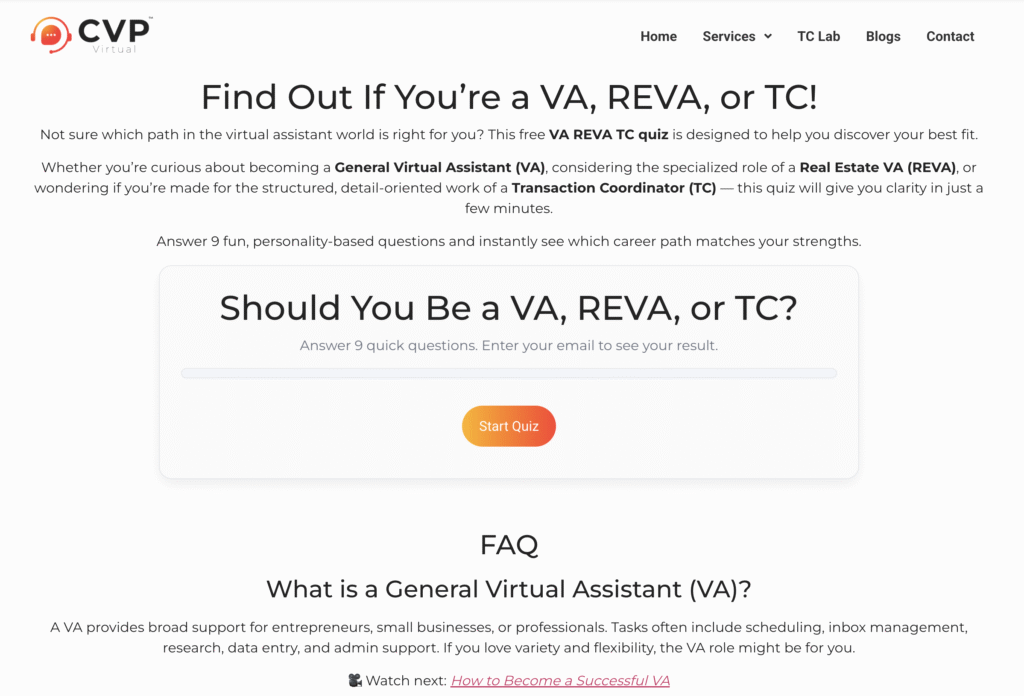
If you’re not completely sure where you fit yet, take the quiz here
That will give you clarity much faster than trying to guess.
Admin Assistant vs Transaction Coordinator: What Actually Changes?
Let’s make this practical.
As an admin assistant, your day might look like:
You receive tasks, you prioritize them, and you complete them based on instructions or shifting priorities.
If something changes, you adjust.
If something is unclear, you ask.
Now compare that to a Transaction Coordinator.
A file comes in with a signed contract, and from that moment forward, there is a sequence of deadlines that will not move just because your day got busy.
Inspection deadlines, financing deadlines, title timelines, closing dates.
Those exist whether you’re ready or not.
And no one is going to send you a task list telling you what to do next.
You are the one expected to know what comes next.
That’s the shift.
It’s not that the work is harder.
It’s that the responsibility is different.
What Admin Assistants Often Misunderstand About This Transition
This is where expectations create problems.
A common assumption is:
“I already do similar work, so this should be easy to pick up.”
And while it’s true that many skills transfer, the environment changes.
For example, in an admin role, missing a step might mean a delay or a follow-up.
In transaction coordination, missing a deadline can impact a deal.
That changes how you approach the work.
Another misconception is expecting agents to guide you through the process.
In reality, most agents hire a Transaction Coordinator because they don’t want to manage the details themselves.
They’re relying on you to bring structure into the transaction.
So instead of being directed, you’re expected to anticipate.
That’s a completely different mindset.
Why Some Admin Assistants Struggle in This Role
This is not about capability.
It’s about how you approach the work.
People who struggle in this transition are usually doing one of the following:
They wait for instructions instead of building a process.
They understand individual tasks but don’t see how everything connects.
They communicate only when something goes wrong instead of keeping everyone informed proactively.
Or they rely too much on tools, thinking the system will do the thinking for them.
The people who succeed tend to do the opposite.
They think in sequence.
They anticipate what’s coming next.
They communicate clearly and consistently.
And most importantly, they build a system they can rely on.
What Skills Transfer—and What You Actually Need to Add
Your admin experience is not wasted.
In fact, it’s your biggest advantage.
You already know how to:
manage information, communicate with multiple people, keep things organized, and follow through on responsibilities.
What you’re adding is context.
You’re learning how those same skills apply within a real estate transaction.
That includes understanding contracts, recognizing what triggers a deadline, knowing what documents are required, and making sure everything is in place for a smooth closing.
So instead of thinking, “I need to learn everything from scratch,” a more accurate way to see it is:
“I need to apply what I already know within a new framework.”
And if you’re still wondering whether not having a real estate background will hold you back, I break that down in detail in this other blog post: Can You Be a Transaction Coordinator Without Real Estate Experience?
Because this is one of the biggest misconceptions people have when they consider this transition.
What the Transition Actually Looks Like (Realistically)
This part matters, because expectations shape how you experience the process.
At the beginning, everything feels disconnected.
You learn about contracts, timelines, communication—but it doesn’t fully click.
Then you start organizing what you’ve learned.
You create a simple workflow.
You run through examples, maybe even mock transactions.
And gradually, things start making sense as a sequence instead of separate pieces.
That’s when confidence starts to build.
Not because you know everything, but because you understand how it fits together.
How to Know If You’re Ready to Move Forward
Instead of asking “Do I know enough?”, ask:
Can I follow a process from beginning to end without needing constant direction?
Can I keep track of multiple deadlines and stay organized?
Can I communicate clearly so others don’t have to guess what’s happening?
If the answer is mostly yes, you’re closer than you think.
If not, that’s not a problem.
It just means you need more structure before stepping into client works.
Where Most People Get Stuck (and How to Move Past It)
The most common place people get stuck is not lack of effort.
It’s lack of direction.
They consume more content, watch more videos, read more posts—but don’t build anything with it.
At some point, the issue is no longer information.
It’s execution.
That’s where having a structured approach makes a difference.
If you’re still trying to understand how everything connects, start with the free training:
3 Principles to Launch Your TC Business on Your Own Terms (Without Endless Research)
This gives you structure so you’re not guessing.
If you want a complete system with workflows, templates, and step-by-step guidance:
If you prefer having someone guide you, answer your questions, and help you apply what you’re learning, that’s where coaching becomes valuable.
What Happens After You Transition?
Once you understand the process and feel confident managing a file, the next step is building your client base.
Because knowing how to do the work is only part of the equation.
Getting paid to do it is the other.
If you want a breakdown of that step, read: How to Get Your First Transaction Coordinator Client.
Key Takeaways
Clarity comes from seeing how everything connects
The transition is realistic, but it requires a shift in responsibility
Your admin skills are a strong foundation
The biggest gap is understanding the process, not learning new skills
Confidence comes from practice and structure
FAQs About Transitioning from Admin Assistant to Transaction Coordinator
Can I transition without real estate experience?
Yes. You’re building on existing skills, not starting from zero.
How long does it take?
With focused effort, many people build a strong foundation within 30 to 60 days.
What’s the hardest part?
Understanding how contracts, timelines, and communication all connect in real scenarios.
Do I need to know specific tools first?
No. Tools come later. The process comes first.
Can I do this part-time?
Yes, as long as you can manage deadlines and communicate clearly with clients.
Final Word
This transition is not about becoming someone new.
It’s about stepping into a role that requires more ownership, more structure, and a clearer understanding of how everything connects.
Once that clicks, everything else becomes easier.
Ready to Take the Next Step?
Free Training: 3 Principles to Launch Your TC Business on Your Own Terms (Without Endless Research)
If you’re ready to build a real TC business and want step-by-step systems, check out my course:
Coordination Virtual Playbook

Cecilia V. Peralta
CVP Virtual
Cecilia Peralta is a Transaction Coordinator, Realtor, and operations specialist who helps real estate professionals implement structured, efficient transaction workflows. After building her own TC business from the ground up, she now shares practical insights to help aspiring and experienced Transaction Coordinators improve their systems, communication, and service quality.